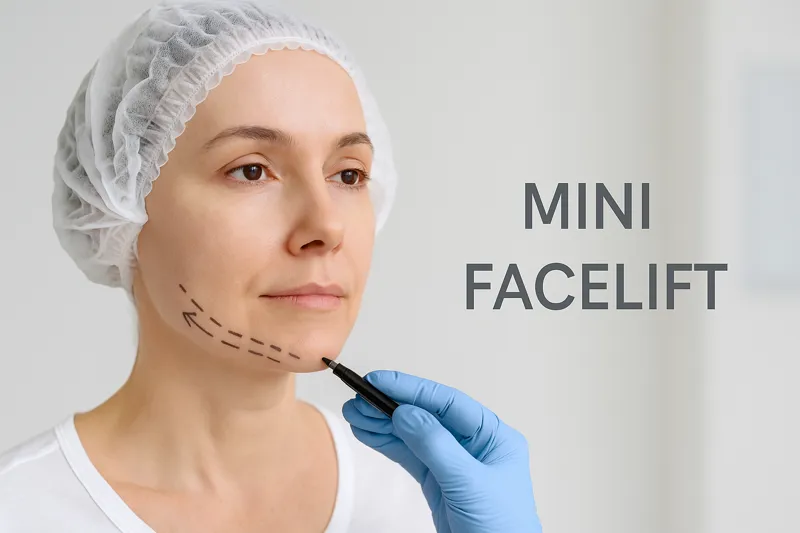
Rediscover a more youthful, refreshed version of yourself with a Mini Face Lift—an advanced facial rejuvenation procedure designed to subtly yet effectively lift and tighten sagging skin around the cheeks, jawline, and lower face. Tailored for men and women seeking natural-looking results without the downtime of a full facelift, this minimally invasive surgery redefines facial contours while preserving your unique features. Trusted by patients across the UK, US, and Europe, our internationally accredited clinic prioritises safety, surgical excellence, and personalised care throughout every step of your journey.
The Mini Face Lift typically involves shorter incisions hidden around the ears, using refined techniques that reposition underlying tissues and remove excess skin. The procedure is commonly performed under local anaesthesia with sedation, allowing for a quicker recovery and fewer risks. Ideal candidates are healthy individuals bothered by early signs of ageing but not yet ready for more extensive surgery.
Patients often report looking refreshed and feeling more confident after healing, which usually takes one to two weeks with proper aftercare. As with any surgical procedure, there are important safety considerations—including swelling, bruising, and rare complications—which our expert team will guide you through with compassionate, thorough support. Explore real patient stories, surgical details, and post-operative guidance throughout this page to help you feel fully informed and confident in your decision.
Types
Mini facelift procedures can be categorized in several ways, primarily based on technique and the area of the face addressed. Here is an overview of the most common types of mini facelift:
Traditional Mini Facelift
The traditional mini facelift targets mild to moderate sagging along the jawline and lower face using smaller incisions than a full facelift. It is less invasive, generally results in quicker recovery, and offers natural-looking rejuvenation.
S-Lift
The S-lift involves a short, S-shaped incision made in front of the ear. This technique lifts and repositions skin and underlying tissues, and is particularly effective for early signs of aging in the lower face and jawline.
The MACS-lift uses a short incision in front of the ear with special suspension sutures to lift sagging tissue. This method is ideal for correcting laxity in the mid- and lower face, with minimal downtime.
Combined Mini Facelift Procedures
Mini facelift can also be combined with other minimal procedures such as neck lift, eyelid surgery, or fat transfer to enhance facial harmony and achieve more comprehensive rejuvenation.
These approaches are particularly suitable for individuals with early signs of aging who do not require a full facelift. The best technique is determined based on the patient's skin type, degree of laxity, and personal goals.
Why it's done
A mini facelift is performed to address mild to moderate sagging of the lower face, define the jawline, and restore a youthful appearance. Advances in aesthetic surgery allow for natural-looking results with smaller incisions, less scarring, and a faster recovery compared to a traditional facelift.
Here are some of the main reasons people choose mini facelift:
To correct mild-to-moderate skin laxity and sagging in the face and jawline
To diminish visible signs of aging and refresh facial contours
To achieve rejuvenation with a shorter recovery time and lower risk compared to full facelift
To improve self-confidence by reducing a tired or sad facial expression
To look more youthful and revitalized in both personal and professional settings
Mini facelift is especially attractive for busy individuals who want natural results and cannot afford extended downtime.
Who it's for
A mini facelift is typically best suited for adults in their 40s to early 50s who are in good general health and have early to moderate facial sagging but still retain decent skin elasticity. Ideal candidates include:
People with mild to moderate laxity in the lower face or jawline
Individuals who want to address early aging signs but do not need a full facelift
Those seeking a less invasive procedure with minimal scarring and a quick recovery
Patients with realistic expectations who understand that a mini facelift yields more subtle results compared to traditional facelifts
Non-smokers, or those willing to stop smoking before and after surgery for optimal healing
Ultimately, candidacy is determined during a consultation with a qualified plastic surgeon, who will assess facial anatomy, skin quality, and personal goals.
Risks
As with any surgical procedure, a mini facelift carries both short- and long-term risks, though the minimally invasive nature reduces overall complication rates. The specific risks depend on individual health status and surgical technique.
Short-term risks:
Swelling, bruising, and mild pain at the incision sites
Temporary numbness or tightness in the treated areas
Minor infection or delayed wound healing
Unfavorable scarring (rare with experienced surgeons and proper care)
Long-term risks:
Unsatisfactory cosmetic results, such as asymmetry or under-correction
Prolonged numbness or skin sensitivity changes
Hematoma or fluid accumulation beneath the skin
Very rarely, nerve injury affecting facial movement
Close follow-up with the surgical team and adherence to postoperative instructions are crucial for minimizing risks and ensuring a smooth recovery.
How you prepare
Proper preparation is key to a safe mini facelift and optimal results. Preparation generally involves the following steps:
Providing a comprehensive medical history, including any previous surgeries, allergies, and current medications
Discussing goals and expectations with your surgeon, and reviewing before-and-after photos of past patients if possible
Undergoing a physical examination of the face and skin to assess suitability for mini facelift
Following preoperative instructions, which may include stopping blood thinners, certain supplements, or smoking for a period before surgery
Arranging for someone to accompany you home and help during the initial recovery period
Preparation may also include lab tests, adjusting medications, and reviewing details about anesthesia and postoperative care.
What you can expect
A mini facelift is usually performed as an outpatient procedure under local anesthesia with sedation or, in some cases, general anesthesia. Here is what patients can typically expect:
The surgeon will make short incisions, usually around the ears or hairline, to access and lift underlying tissues
Excess skin is trimmed, and deep tissues are repositioned to restore youthful contours
Incisions are closed with fine sutures; in most cases, scars are well-concealed within the natural contours of the ear or hairline
Patients can often go home the same day, with a light dressing placed over the face
Initial swelling and bruising subside within 1-2 weeks; most patients return to normal activities within 7-10 days
Regular follow-up visits will be scheduled to monitor healing and address any concerns
Careful adherence to post-surgical instructions helps ensure the best possible outcome.
Types of Mini Facelift Treatments
Mini facelift procedures can be performed alone or in combination with other minimally invasive facial treatments for enhanced results:
Surgical Mini Facelift
The core procedure, involving tightening and lifting of the lower facial tissues through short incisions.
Adjunctive Non-Surgical Treatments
Dermal fillers, fat transfer, and skin resurfacing can be used alongside mini facelift to further rejuvenate the face, address volume loss, and refine skin texture.
Neck Tightening or Liposuction
In select cases, neck contouring is performed simultaneously for more harmonious results.
The best treatment plan is determined based on individual needs and discussed during the surgical consultation.
After Mini Facelift
Recovery and aftercare following a mini facelift are generally straightforward and quicker than with traditional facelift surgery:
Expect mild discomfort, swelling, and bruising for several days, typically managed with oral pain medication and cold compresses
Patients should keep their head elevated and avoid strenuous activities for 1-2 weeks
Incision care is important; keep sites clean and follow all instructions regarding bathing and wound care
Most people return to work and social activities within 7-10 days, though complete healing and final results may take several weeks
Follow-up appointments are necessary to monitor progress and remove any sutures as needed
Maintaining a healthy lifestyle, protecting the skin from sun exposure, and following long-term skincare recommendations will help extend results.
Results
A mini facelift can significantly enhance facial contours, provide a more youthful appearance, and boost self-confidence. Common benefits include:
Restored definition of the jawline and lower face
Reduction of mild-to-moderate sagging, with natural-looking results
Minimal scarring and a faster return to daily life compared to traditional facelift
Improved facial harmony and a refreshed appearance
Lasting results, especially with healthy lifestyle and skin care habits
Individual results vary, but most patients experience a noticeable yet subtle rejuvenation that maintains their natural expressions.
When Mini Facelift Doesn’t Work
While mini facelift procedures are highly effective for many, there are situations in which results may fall short of expectations or further treatment may be needed:
Inadequate Candidate Selection: Patients with advanced skin laxity or significant sagging may not achieve optimal results and could benefit more from a full facelift.
Unrealistic Expectations: It’s important to understand that a mini facelift provides subtle improvements; dramatic changes may not be possible.
Non-Compliance: Not following pre- and postoperative instructions, including wound care or activity restrictions, can impact outcomes.
Healing Variability: Individual healing responses vary, and factors such as genetics, smoking, or underlying health conditions can affect recovery and final results.
If results are unsatisfactory, patients should consult with their surgeon to discuss revision procedures or complementary treatments. Ongoing communication and realistic planning are key to long-term satisfaction and facial rejuvenation success.
Mini facelift is an excellent option for many seeking early facial rejuvenation with limited downtime. With thorough consultation, skilled surgical care, and appropriate aftercare, most patients enjoy refreshed, natural results and a renewed sense of confidence.
This is Amelie - Your Medical Coordinator
Let’s help you understand the treatment process in Turkey and find the most suitable doctors for your needs